Reports the SF Sidewalk Astronomers:
"Stargazing is the subject of Seeing in the Dark, a 60-minute, state-of-the-art, high-definition (HDTV) documentary by Timothy Ferris that premieres September 19, 2007 at 8:00 p.m. on PBS (check local listings).
The film, Ferris's third, is based on his book, _Seeing in the Dark_ (2002), named by the New York Times as one of the 10 best books of the year.
Seeing in the Dark will bring the wonders of the night sky in state-of-the-art HDTV to millions of viewers. The program features remarkable high-definition astrophotography, as well as the men and women, professionals and amateurs, who have seen and captured phenomenal images within and beyond our solar system and galaxy. It also explores how inexpensive telescopes, sensitive digital cameras, and the Internet now enable casual stargazers to get in touch with the cosmos.
Like the book, the film is in part a personal account of Ferris' life-long devotion to stargazing, beginning with his introduction to the night sky as teenager in Florida in the '50s.
'Seeing in the Dark is meant to alter, inspire and illuminate the lives of millions,' said Ferris. 'It introduces viewers to the rewards of first-person, hands-on astronomy--from kids learning the constellations to amateur astronomers doing professional-grade research in discovering planets and exploding stars. I hope it will encourage many viewers to make casual stargazing part of their lives, and a few to get into serious amateur astronomy.' "
Via Matthew Ota, Orange County Astronomers mailing list.
Saturday, July 28, 2007
Seeing in the Dark


Saturday, July 14, 2007
In the Shadow of the Moon

That's why you should go see this movie when it hits theatres in September.
In the Shadow of the Moon
A film by Ron Howard
"Between 1968 and 1972, nine American spacecraft voyaged to the Moon, and 12 men walked upon its surface. IN THE SHADOW OF THE MOON brings together for the first, and possibly the last, time surviving crew members from every single Apollo mission that flew to the Moon along with visually stunning archival material re-mastered from the original NASA film footage. The result is an intimate epic that vividly communicates the daring, the danger, the pride, and the promise of this extraordinary era in history when the whole world literally looked up at America."
Watch the trailer:
http://www.apple.com/trailers/thinkfilm/intheshadowofthemoon/
I would also highly recommend Ron Howard's other Apollo film projects, APOLLO 13 (which is well-known), and the lesser known (but more extensive and therefore much more valuable) mini-series produced with Tom Hanks, FROM THE EARTH TO THE MOON (1998).
FROM THE EARTH TO THE MOON chronicles the entire Apollo development, in 12 episodes, from the dawn of the Space Race to the government's scrapping of the project in 1972. It is presented in dramatized form. If you have ever seen footage of the Moon landing, or a rocket taking off, and you got shivers, then you will greatly enjoy this series. Anyone who wishes to know initimately and directly the great achievements of our past, would be remiss to never see this series.
(Perhaps you can watch it before IN THE SHADOW OF THE MOON comes out in September!)
Hat tip: Jared Seehafer.
Tuesday, July 10, 2007
Volcano on Io

The New Horizons spacecraft (previously blogged about here), en route to Pluto but currently at Jupiter orbit, captured on February 26, 2007 the first ever movie of a volcano erupting on Io. You can watch it here: http://pluto.jhuapl.edu/gallery/missionPhotos/pages/051407.html
FYI: If you know where to look for Jupiter in the sky, you can resolve the Galilean satellites with steady hands and a pair of binoculars, but they look even better through a modest telescope.
Further reading: Wikipedia articles: Observational History of Io; Name (incl. naming scheme for its features).
Hat tip: Jeff Bryant via CUAS listserv.
Sunday, June 10, 2007
Nestcam
http://www.bigbearshores.com/nestcam/nestcam.htm
It's a webcam trained on a Steller's Jay nest at Big Bear Lake. It refreshes every five minutes.

Unfortunately, I'm a little late in posting this. Sandra first observed the chicks around May 20 (around which time she captured these frames).

As of June 8 the chicks were down to two, were very big, and one was out of the nest for a while two days before.
That seems like a rather rapid fledging to me, but I don't actually know the precise fledging periods of any birds off the top of my head, so here's a note to myself to look into that.
I know that Steller's Jays, like all jays (including Blue Jays, Scrub Jays, and Green Jays), are members of the Corvid family, which includes crows, ravens, and magpies. I've been getting cozy with ravens over the course of the last six weeks, reading Bernd Heinrich's Mind of the Raven. I've found it a real eye-opener, in terms of seeing the value for me of ethology--the scientific study of animal behavior. I have some things to say about this book, which I hope to do as my (somewhat more flexible) summer schedule permits, in a week or so.
Wednesday, May 16, 2007
The Killer Tortoise
Everyone who has ever kept a turtle as a pet knows that they are relatively shy and always tuck in their shells at the slightest hint of danger.
Right?
Wrong.
Thursday, May 03, 2007
Snail Sex
Land snails are easy captives to maintain: if your life gets too busy, they are perfectly content to "clamp down" and wait it out until you find the time to feed and water them.
But more importantly they are fun to observe, most of all because they engage in snail sex. Two nights ago, for the first time I observed my snails in the act. (See below photo.) After five minutes of back-and-forth nibbling each other's foot and retreating, they then entwined their sexual organs, which are located along the sides of their heads, and stayed that way for at least 30 minutes if not longer (unfortunately I had to get to sleep and could not time it.)
Here's a relevant and highly recommended clip, via YouTube, from David Attenborough's Life in the Undergrowth.
I've read that snails are hermaphroditic, so then it would seem these two snails of mine are exchanging both male and female sex cells. (Not that there's anything wrong with that.)

Friday, March 02, 2007
Partial Lunar Eclipse Tomorrow (But Not For Me)
"This Weekend's Lunar Eclipse"
I won't be able to see it from California--the moon will have already grazed the Earth's shadow just before moonrise. I guess I'll just have to content myself with the sunny, 72 degree weather we have here instead. : P

Photo: a partial lunar eclipse in progress. If you didn't know any better, you might just think this is a crescent moon. But any familiarity with the curvature of the moon's usual shadow will inform you that something is amiss here--that's not a plain old crescent moon, it's a full moon passing through the shadow of the Earth! (And note that tomorrow night, the moon will be a full moon--so if you see anything otherwise, you can be sure it's the Earth's shadow involved.)
It is interesting to contemplate what one would see during a lunar eclipse if one were standing on the surface of the Moon: from the lunar perspective, it would in fact be a solar eclipse!What would that look like, given that the Earth would appear much larger in the sky than the Sun? Well, you would see a ring of "sunlight streams" encircling the outside edge of the Earth's sphere--in other words, the sum of all sunsets happening at that moment on the Earth. It would undoubtedly look like a ring of reddish-orange. Two graphic artists have illustrated how that might appear: here is a high-quality composite illustration, imagined at the point immediately before or after the Sun is fully blocked (an effect known as "Bailey's Beads"), and here is an more instructive (though lower quality) animation of the process--to see it you'll have to scroll down to the second image on the page.
Friday, November 10, 2006
Cassini Spacecraft Observes Hurricane at Saturn's South Pole

This 14-frame movie shows a swirling cloud mass centered on the south pole, around which winds blow at 550 kilometers (350 miles) per hour.
Thursday, October 19, 2006
Making a Mockery of Birds
Wednesday, October 18, 2006
Alas (for some), Shakespeare Knew His Starlings Well
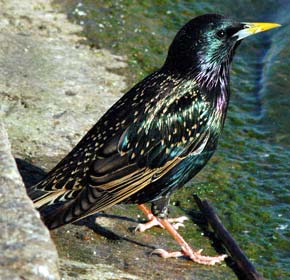 Going about my daily activities today, I was struck by the fact that I noticed STARLINGS in several places around town. Now, I know that these are common birds (estimated 200 million individuals in North America alone, with a range covering most of the continent), but even so, I think I'm almost always attentive to what types of bird I'm seeing about me.
Sibley's Bird Life & Behavior (one of the holy scriptures for North American bird enthusiasts) reports that whether starlings migrate depends on how far north they are, but on this it does not elaborate further.
It's also amazing to contemplate that every single starling in North America today is a descendant of the small population of mere dozens (~60-100) released in Central Park in 1890. (you can find this fact cited everywhere--Sibley, Audubon guide, etc.) How bizarre that apparently the motive for this was to introduce New Yorkers to all of the birds mentioned in the plays of Shakespeare! One Eugene Schieffelin, a member of the Acclimation Society of North America, is responsible.
And did you know that starlings are adept at imitating sounds? It's true. They often imitate birds of their surroundings. Perhaps not surprising then to learn that they are closely related to Mynabirds (both are in the "Sturnid" family of songbirds). It's this ability to imitate which led Shakespeare to reference them in his play Henry IV, read the quote here.
Thursday, October 12, 2006
Holidays in Space: Book Now!
“It seems almost unbelievable, but it is the reality.”
Clarification: The reason I have linked to the above, is that there is a movie there you should see. Once you click on the link, wait for it to appear (then click on it, when it says "View the Movie").
