Everyone who has ever kept a turtle as a pet knows that they are relatively shy and always tuck in their shells at the slightest hint of danger.
Right?
Wrong.
Showing posts with label they make great pets. Show all posts
Showing posts with label they make great pets. Show all posts
Wednesday, May 16, 2007
The Killer Tortoise


Thursday, May 03, 2007
Snail Sex
It seems like every animal exhibits unique and interesting behavior worthy of observation. Here is a post about land snails.
Land snails are easy captives to maintain: if your life gets too busy, they are perfectly content to "clamp down" and wait it out until you find the time to feed and water them.
But more importantly they are fun to observe, most of all because they engage in snail sex. Two nights ago, for the first time I observed my snails in the act. (See below photo.) After five minutes of back-and-forth nibbling each other's foot and retreating, they then entwined their sexual organs, which are located along the sides of their heads, and stayed that way for at least 30 minutes if not longer (unfortunately I had to get to sleep and could not time it.)
Here's a relevant and highly recommended clip, via YouTube, from David Attenborough's Life in the Undergrowth.
I've read that snails are hermaphroditic, so then it would seem these two snails of mine are exchanging both male and female sex cells. (Not that there's anything wrong with that.)

Land snails are easy captives to maintain: if your life gets too busy, they are perfectly content to "clamp down" and wait it out until you find the time to feed and water them.
But more importantly they are fun to observe, most of all because they engage in snail sex. Two nights ago, for the first time I observed my snails in the act. (See below photo.) After five minutes of back-and-forth nibbling each other's foot and retreating, they then entwined their sexual organs, which are located along the sides of their heads, and stayed that way for at least 30 minutes if not longer (unfortunately I had to get to sleep and could not time it.)
Here's a relevant and highly recommended clip, via YouTube, from David Attenborough's Life in the Undergrowth.
I've read that snails are hermaphroditic, so then it would seem these two snails of mine are exchanging both male and female sex cells. (Not that there's anything wrong with that.)
Sunday, February 18, 2007
ﻟﻭﺭﺍﻟﻮ (Laura Lu)
 Our hamster, Laura, died this morning. It was not unexpected--she was at least two years old, which as I understand is ripe old age for hamsters.
Carrie and I thought she was the cutest little rodent we had ever seen--until one day we noticed that she looks like every other hamster at the pet store (and almost certainly acts like them, too). Even so, whether we could recognize her uniqueness or not, we can know that she was her own being.
And for a hamster, you could say she led an exciting life.
Originally rescued from a burning building and given to me by a volunteer from the local fire department, I acquired her just days after graduating from college. She moved with us three times—first with me to my temporary apartment attached to my cousin’s garage (which prompted me to name her after my cousin's wife), then with us to our rental house in Urbana, and finally to our apartment in Champaign.
She had a calm and curious disposition, and never bit anyone her whole life. She didn't mind being handled, although she didn't seem to enjoy it either. Like all hamsters, she exercised regularly in her ball--stopping occasionally to peek her head out and see if she'd made any progress in tunneling through the surrounding landscape. : )
When we would set her loose in her ball within the apartment, she was never afraid of cats--on the contrary, she seemed to antagonize them! Clyde, and Mike (the cat we catsitted for each summer), would stare nervously at her oncoming ball--seemingly only able to perceive the single, solitary sphere headed ominously in their direction and not the delectable, plump little rodent powering it inside. (In fact Mike would run and hide, trembling in fear.)
 (Photo: Laura fast asleep within a mound of wood shavings, taken summer 2006.)
In appearance she was a roley, poley pudgeball; never a stranger to food. The fat little thing would sit like a Buddha statue in the corner of her tank, and groom her feet or nibble on a special treat provided occasionally by us (raisins and carrots were her top favorites). She had a habit of picking through her food bowl each time I'd refresh it, in order to sift out her favorite grains first. She'd nibble those, then hoarde a few into her cheek pouches--you see, the name "hamster" is derived from the German word for "Hoarder", hoarding being the sine qua non of hamster behavior--and she would stash them into her nest for a "midnight snack". ("Because you just never know..." as Carrie used to say about it.)
 Hamsters are originally from Syria--I read once that they were imported in the first few decades of the 1900s and their pethood status began from there. Accordingly, above the entrance to Laura's little house, I had written in Arabic:
ﻟﻭﺭﺍﻟﻮ,ﮬﻤﺴﺘﺮ ﺳﻮﺭﻳﺎ
ﺳﱢﻴﺩﺓ ﺩﻣﺸﻖ
"Laura Lu, Hamster of Syria, Lady of Damascus". (Laura Lu was her nickname).
By trade you could say she was an interior designer--she would stuff the inner corners of the house with wood shavings (for extra comfort and warmth) and was also fond of making a great pile out of her wood shavings outside her house and curling up into a cozy ball within that. (See the above photo.)
And so even though she's probably like every other hamster out there, she was our sweet little Laura Lu and we'll miss her--and the two of us feel a bit sad today. I'm at least glad to know that she did not suffer for long: Carrie reported last night that she'd seen her shaking a little these past two days, but was otherwise okay (and was even eating and still moving about). As of this morning she was up and walking around but kept falling down. In a final moment, she walked over to her little house, snuggled inside of it, and found some peace.
...
I don't believe in life after death (I do believe that heaven is right here), but as I've started to say recently: if I had to pick an afterlife fantasy to believe in, I'd choose reincarnation--for the obvious reason that I love this world. So to the memory of our enjoyable little rodent: Laura, I hope that you're reincarnated as the animal of your choice. If I can put in a word for being human, of course I cannot recommend anything less... man is the most glorious animal of all. But do know that if instead you choose to be a hamster again, I am somewhat sympathetic--you made it look like fun.
And rest in peace, our little creature.
Wednesday, October 11, 2006
A "Mantidote" for the Wintertime Blues?
(Subtitle: Pray tell!)
Despite the dark pleasures of autumn, which I alluded to in my last post, we know that it all comes to an end about this time November. Strong winds will have stripped that very last vestige of life—the leaves—from the surrounding landscape, and one is left coping with winter’s stark dormancy. This is certainly a cause for depression among creature-lovers.
But mope not, because if you act now, you can preserve one of summer’s treasures to last you well into the winter season. And it’s as simple as this: Go outside right now and catch yourself a praying mantis.
The fact is, as one of the largest insects in North America, praying mantises make a particularly symbolic piece of warmer weather memorabilia. They’re also a great wild animal to collect at this time of year. And here, I think, are the top three reasons why:
Despite the dark pleasures of autumn, which I alluded to in my last post, we know that it all comes to an end about this time November. Strong winds will have stripped that very last vestige of life—the leaves—from the surrounding landscape, and one is left coping with winter’s stark dormancy. This is certainly a cause for depression among creature-lovers.
But mope not, because if you act now, you can preserve one of summer’s treasures to last you well into the winter season. And it’s as simple as this: Go outside right now and catch yourself a praying mantis.
The fact is, as one of the largest insects in North America, praying mantises make a particularly symbolic piece of warmer weather memorabilia. They’re also a great wild animal to collect at this time of year. And here, I think, are the top three reasons why:
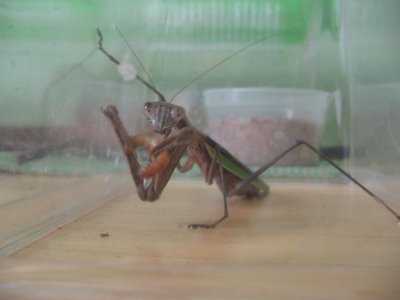
(Jerry the Praying Mantis, munching on a beetle larva.)
Number 1: They seem to be readily abundant. That’s undoubtedly something to do with their life cycle: females lay up to 300 eggs, with some hatching in small intervals. And that brings us to...
Number 2: They’re just going to die anyway. That’s because they hatch out in the spring, spend all summer preying (and “praying”), mate & lay their eggs in the fall, and then promptly die from old age or frost, "whichever comes first”.
And finally, Number 3: They are simply amazing to behold. I know, because I kept one last year—his name was Jerry. Fascinatingly, mantises are one of the few insects that can rotate their heads. They also appear to have excellent vision (their eyes are a curiosity unto themselves), and a mantis’ motions and behaviors seem almost as intelligent as those of a small vertebrate.
Of the four or five people who read this blog, I know I’ve got at least one predator-lover out there (you know who you are), so I’ll now say something a bit gory regarding how a praying mantis captures and consumes its prey. (The faint of heart should read no further.) Jerry would hang upside down and ‘swoop’ his spiny forelegs down to capture an unsuspecting cricket. Grasping it tightly to the point that it could not move, he would then chew a small, rectangular incision into the top of the cricket’s thorax (just below the vestigial wings), and proceed to munch the life right out of it. It’s awesomely gruesome, and guaranteed to send shivers right down your spine! (In fact I just got shivers merely thinking about it again.) Happily, no mantis poses any serious threat to human beings, though the mandibles can deliver a painful pinch, so just remember not to be foolish (like I was) and pick them up.
By the way, once your praying mantis finally kicks the bucket, you can easily preserve him for years (and quite nicely) with ethyl alcohol or formaldehyde. Barring that, rubbing alcohol will keep him looking like a sharp souvenir for several months.
Happy bugging, everybody!
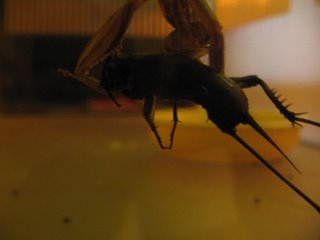
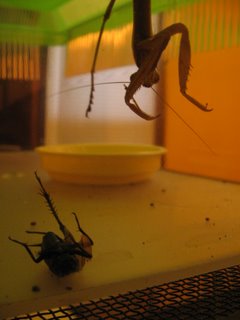
PS: To prove to yourself what awesome predators praying mantises are, be sure to check out this website, Praying Mantis Makes Meal of a Hummingbird (it's for real!).
Update: From Wikipedia, more excellent photos of mantids here, including a link to a YouTube! video of a mantis capturing a cricket.
Subscribe to:
Posts (Atom)
