I really enjoyed this series of photographs. (Be sure to click "Next Page" at the bottom.)
Hat tip: Uncle Duane.
Showing posts with label adventures in amateur naturalism. Show all posts
Showing posts with label adventures in amateur naturalism. Show all posts
Sunday, August 05, 2007


Friday, August 03, 2007
Coyotes!
I know that sometimes coyotes are within earshot of the school I work at, because my colleague Ray would hear them a couple of years ago when he was working late at night.
But I was very surprised to hear them just now, sitting here in my classroom planning lessons, because it's three o'clock in the afternoon.
Man are they loud! It's a whole orchestra of howls, concentrated a hundred yards or so away in the scrub along the base of a cliff that runs in front of the school. (So there's little doubt in my mind that it is definitely a pack of coyotes, and not just neighborhood dogs.)
My Google search "Why do coyotes howl?" provided a good clue as to why these coyotes might be howling in the middle of the day: underneath their ruckus, I could hear an emergency vehicle siren in the distance.
It is eerie and forboding to stand outside right now, especially when they are so close. I can't imagine how much more eerie it would be in the dark!
But I was very surprised to hear them just now, sitting here in my classroom planning lessons, because it's three o'clock in the afternoon.
Man are they loud! It's a whole orchestra of howls, concentrated a hundred yards or so away in the scrub along the base of a cliff that runs in front of the school. (So there's little doubt in my mind that it is definitely a pack of coyotes, and not just neighborhood dogs.)
My Google search "Why do coyotes howl?" provided a good clue as to why these coyotes might be howling in the middle of the day: underneath their ruckus, I could hear an emergency vehicle siren in the distance.
It is eerie and forboding to stand outside right now, especially when they are so close. I can't imagine how much more eerie it would be in the dark!
Wednesday, July 25, 2007
Rattlesnake!
We saw one!
This evening!
Along our favorite nearby neighborhood trail!
We approached it, though keeping a safe distance!
It rattled at us!
It was freaking awesome!!
Here's a picture! Woo hoo!


This evening!
Along our favorite nearby neighborhood trail!
We approached it, though keeping a safe distance!
It rattled at us!
It was freaking awesome!!
Here's a picture! Woo hoo!
Sunday, April 22, 2007
An Update
I've been fairly busy of late, thus no posts. But my life and mind have been fertile with respect to nature adventures and ideas, so I've got plenty brewing for future posts.
In the interrim, here's an update:
1. I had a week of no classes (Spring Break), and in some of that time I managed to do some intended thinking and reading about "ecology". It isn't prudent for me to share my (premature) thoughts, though here is an article about the meaning of "invasiveness" (e.g. plants) that I found really interesting.
In the interrim, here's an update:
1. I had a week of no classes (Spring Break), and in some of that time I managed to do some intended thinking and reading about "ecology". It isn't prudent for me to share my (premature) thoughts, though here is an article about the meaning of "invasiveness" (e.g. plants) that I found really interesting.

2. my wife, parents, and oldest niece came for a visit last weekend. A great time was had by all. (Photo: On the left are Carrie & my Mom, treading cautiously through the treacherous tidal potholes; centered are Madeline and I, reenacting a scene from our favorite movie.)
My wife stayed for the week, and left yesterday to return to Champaign for her last extended stay!!! (Only six weeks now till she joins me in California!). To see photographs from their visit, go to:
http://uillinois.facebook.com/album.php?aid=2218225&l=fa675&id=1909291
And some miscellaneous photographs (mostly from Carrie's & my trip to San Diego Natural History Museum):
http://uillinois.facebook.com/album.php?aid=2218776&l=b6a03&id=1909291
Saturday, March 03, 2007
Festival of Whales

Today marked the beginning of Dana Point's city festival, Festival of Whales, so to observe the occasion I went on the "Marine Mammal Cruise" this morning offered by the Ocean Institute (of which I am now a member).
Despite the expectations, to everyone's surprise (including the onboard marine biologists) there was only one whale sighted--a juvenile Grey Whale leisurely heading northwards and coming up to breathe, at closest approach, about 100 ft. off the bow of the ship. As he dipped down under the water for the last time, he showed us his fluke (above photo).

But by far the highlight of the trip occurred within the first 10 minutes--about a mile out to sea the captain sighted a pod of Common Dolphins--what he estimated was around 300 individuals! (Above photo.) As opposed to shy whales, dolphins actively approach the ship, because they like taking advantage of the currents and waves it creates--and so we headed over to them and they surrounded us like a swarm of bees. The usual descriptions of dolphins as intensely inquisitive and playful animals definitely applies here. They were gaily swimming, coming up for air, and sometimes jumping on all sides of us. A particularly thrilling moment was when there were several dolphins swimming and breathing about six feet under my feet as I stood on the ship's bow, some of them juveniles and calves (below photo). As they swarmed us, the ship's captain spoke to the dolphins over the loudspeakers: "Man, I don't know what kind of coffee you guys had this morning, but I want some of it!"
 We left this pod behind and headed south. At about a mile northwest of San Onofre Beach (next to Camp Pendleton), the captain spotted a solitary pair of Bottlenose Dolphins a hundred yards ahead of us. Their solitary travel was something neither he nor any of the on-board marine biologists had ever seen before: dolphins usually travel in pods of tens or hundreds.
 To add to the uniqueness of this, we all soon observed that one of the dolphins had a malformed fin. As we got closer, the captain pointed out that it wasn't just the fin--something was deformed about the dolphin's whole tail region as well. (Indeed, I saw it.) One of the marine biologists said that this was clearly a genetic deformity, not an injury. It is interesting to speculate whether this would explain why the dolphins weren't part of a pod--perhaps it was a calf who couldn't keep up, accompanied by its mother, who wouldn't abandon it. I asked the marine biologists if anything is known of this kind of behavior. (They didn't know.) I asked further if it was something they would seek to follow up on themselves, or at least report to other marine biologists. (They said "probably not", and did not seem interested in it.)

Shortly thereafter, we encountered a small pod of Pacific White-sided Dolphins--numbering probably somewhere between 12 or 20.
And as our finale, we got to see the one Grey Whale as described above--a juvenile (so, in other words, "small"... but that means about the size of a car!). I did also spot a seal, probably a California Sea lion, just outside Dana Point Harbor. And the views of the landscape alone, as seen from sea, made the trip worthwhile: Santa Catalina Island, San Onofre Beach (with its incredible, dome-shaped nuclear power plant), the cliffs at Dana Point, the Santa Ana Mountains, even the snow-capped San Gabriel Mountains, to the northeast. I ask myself: why would anyone live anywhere else?
I'm hoping that I will get to see even more grey whales when I go on this cruise again in mid-March, alongside my wife and our friends. The grey whales have usually finished their migration (mostly from Baja California up to Alaska) by the end of March, although today I was told that it's sometimes possible to spot them as late as mid-May.
And then it's just a couple months' lull until it's time for the blue whales--which are the largest animals ever to have inhabited the earth. (I can't wait!)
Saturday, February 03, 2007
Not Bad for My First Week: The True Story of Peltz & the Rhinoceros Auklet
It's been a month since my last post and needless to say I have now arrived in Southern California and am very happily settled in my new home along the Orange Coast: a cozy apartment in Monarch Beach (a community within the city of Dana Point). And my universe would be a completely perfect, sunny California one if only my wife were here with me...
I did not have camera at hand (lesson now learned, of course!). I wanted to take in and remember its details, so that I could later look it up, so I quickly looked over its major features and helped myself remember them by giving each a short description in my head:
I haven't posted in nearly a month. Here's a story I've been meaning to post--definitely Peltz At Hand-worthy for the month of January:
While walking along Aliso Beach at sundown (South Laguna), I stumbled upon an apparently sick bird, which from a distance I took to be a raven. Upon closer inspection, however, I realized this was not the case and was immediately bothered at not being able to identify it.
I did not have camera at hand (lesson now learned, of course!). I wanted to take in and remember its details, so that I could later look it up, so I quickly looked over its major features and helped myself remember them by giving each a short description in my head:
1. coloration: purely black on top, purely white on bottom--sharp divide between the two colors
2. body shape & size: about the same size as an adult Mallard duck. Shape is penguin or puffin-like.
2. body shape & size: about the same size as an adult Mallard duck. Shape is penguin or puffin-like.
3. feet: webbed, duck-like.
4. bill shape & size: tubular, almost gull-like--not broad like a puffin's bill.
5. distinctive features: It also had a fine, white feather filament on the side of the head--very distinct.
5. distinctive features: It also had a fine, white feather filament on the side of the head--very distinct.
With the exception of the bill, I decided the bird was essentially very puffin-like, and that this might be very odd, given that to my knowledge there are no puffins along the Pacific Coast, much less in Orange County!
While standing there with the bird, using my cellphone, I called Laguna Beach Animal Control, and received an answering machine, so I left a message and gave them my thoughts on the bird's identity. They did not show up, but I had managed to flag down a passerby, and collectively, we attracted the attention of the owner of nearby house overlooking the Beach. He informed us of our precise location, which information I passed on to the Animal Control's answering machine--just in case they might receive the message later in the evening and try to act on it after dark.
Sitting with the bird for nearly an hour, I gave up in exasperation around 6:30pm, sensing full well the possible rarity of this bird.
That evening, I posted the details of this event, along with my description, to the Orange County Birding email list. I was delighted to receive, the very next day, the following message from someone on the list, who is also affiliated with the Laguna Beach Animal Control:
"We received a Rhinoceros auklet (Cerorhinca monocerata) from Laguna Beach animal control yesterday evening at 7:30pm. I believe that is the same bird that you saw. Unfortunately the bird did not make it. It will be going to Kimball Garrett at the Natural History Museum for their display."
While standing there with the bird, using my cellphone, I called Laguna Beach Animal Control, and received an answering machine, so I left a message and gave them my thoughts on the bird's identity. They did not show up, but I had managed to flag down a passerby, and collectively, we attracted the attention of the owner of nearby house overlooking the Beach. He informed us of our precise location, which information I passed on to the Animal Control's answering machine--just in case they might receive the message later in the evening and try to act on it after dark.
Sitting with the bird for nearly an hour, I gave up in exasperation around 6:30pm, sensing full well the possible rarity of this bird.
That evening, I posted the details of this event, along with my description, to the Orange County Birding email list. I was delighted to receive, the very next day, the following message from someone on the list, who is also affiliated with the Laguna Beach Animal Control:
"We received a Rhinoceros auklet (Cerorhinca monocerata) from Laguna Beach animal control yesterday evening at 7:30pm. I believe that is the same bird that you saw. Unfortunately the bird did not make it. It will be going to Kimball Garrett at the Natural History Museum for their display."
It turns out that the Rhinoceros Auklet is one of three members of the Puffin family, and the only member to reside in the Pacific Ocean.
Did you get that? So in my first week of residence in Orange County, I used my budding knowledge of birds to correctly identify a somewhat rare bird for the county, which is going to be placed on display at the Orange County Natural History Museum.
I couldn't be more smitten with myself.
I couldn't be more smitten with myself.
A native of the Pacific Northwest & Japan, the Rhinoceros Auklet comes to the Channel Islands to breed in winter, but not usually to the Orange County coast. So it is in fact somewhat rare--I think thus why the Natural History Museum would have an interest in obtaining it.
Below is an illustration of the bird--it's the only picture I could find in the public domain. (Note that the illustration refers to it by an older common name, the Horned-billed Guillemot):
Wednesday, October 18, 2006
Alas (for some), Shakespeare Knew His Starlings Well
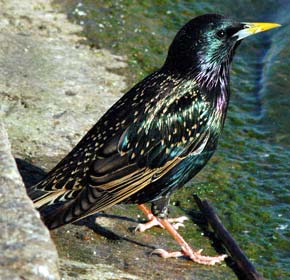 Going about my daily activities today, I was struck by the fact that I noticed STARLINGS in several places around town. Now, I know that these are common birds (estimated 200 million individuals in North America alone, with a range covering most of the continent), but even so, I think I'm almost always attentive to what types of bird I'm seeing about me.
That led me to wonder if perhaps they migrate--since in the Arctic & temperate latitudes so many birds this time of year are now making their preparations (if not already en route), which generally involves first a giant "meet up" or flocking.
Sibley's Bird Life & Behavior (one of the holy scriptures for North American bird enthusiasts) reports that whether starlings migrate depends on how far north they are, but on this it does not elaborate further.
Sibley's Bird Life & Behavior (one of the holy scriptures for North American bird enthusiasts) reports that whether starlings migrate depends on how far north they are, but on this it does not elaborate further.
So I posed the question to the local birdwatchers' list. The response? No one knows for sure whether the currently resident population stays, but I'm told there are definitely starlings around here in winter. So it seems likely then, that they do not migrate.
I realize starlings are not usually a bird we think of as particularly attractive--besides I was reading about what a threat they pose to less common, cavity-nesting birds, such as woodpeckers (apparently they can be quite aggressive and will evict them). Nonetheless, I have to say in their defense: a few moments' observation of them reminded me of just what a fine and unique plumage they have. I love not only the spots, but those shaggy feathers on the throat and breast with the quality of a feather boa.
It's also amazing to contemplate that every single starling in North America today is a descendant of the small population of mere dozens (~60-100) released in Central Park in 1890. (you can find this fact cited everywhere--Sibley, Audubon guide, etc.) How bizarre that apparently the motive for this was to introduce New Yorkers to all of the birds mentioned in the plays of Shakespeare! One Eugene Schieffelin, a member of the Acclimation Society of North America, is responsible.
And did you know that starlings are adept at imitating sounds? It's true. They often imitate birds of their surroundings. Perhaps not surprising then to learn that they are closely related to Mynabirds (both are in the "Sturnid" family of songbirds). It's this ability to imitate which led Shakespeare to reference them in his play Henry IV, read the quote here.
It's also amazing to contemplate that every single starling in North America today is a descendant of the small population of mere dozens (~60-100) released in Central Park in 1890. (you can find this fact cited everywhere--Sibley, Audubon guide, etc.) How bizarre that apparently the motive for this was to introduce New Yorkers to all of the birds mentioned in the plays of Shakespeare! One Eugene Schieffelin, a member of the Acclimation Society of North America, is responsible.
And did you know that starlings are adept at imitating sounds? It's true. They often imitate birds of their surroundings. Perhaps not surprising then to learn that they are closely related to Mynabirds (both are in the "Sturnid" family of songbirds). It's this ability to imitate which led Shakespeare to reference them in his play Henry IV, read the quote here.
UPDATE: Perhaps I should add that starlings are notoriously gregarious. A fellow birdwatcher informs me that they are the birds that lately can be seen in the evenings congregating by the hundreds on telephone wires and powerlines before going off to roost. Here is amazing video proof of just how gregarious they can be--you don't want to miss this!
Wednesday, October 11, 2006
A "Mantidote" for the Wintertime Blues?
(Subtitle: Pray tell!)
Despite the dark pleasures of autumn, which I alluded to in my last post, we know that it all comes to an end about this time November. Strong winds will have stripped that very last vestige of life—the leaves—from the surrounding landscape, and one is left coping with winter’s stark dormancy. This is certainly a cause for depression among creature-lovers.
But mope not, because if you act now, you can preserve one of summer’s treasures to last you well into the winter season. And it’s as simple as this: Go outside right now and catch yourself a praying mantis.
The fact is, as one of the largest insects in North America, praying mantises make a particularly symbolic piece of warmer weather memorabilia. They’re also a great wild animal to collect at this time of year. And here, I think, are the top three reasons why:
Despite the dark pleasures of autumn, which I alluded to in my last post, we know that it all comes to an end about this time November. Strong winds will have stripped that very last vestige of life—the leaves—from the surrounding landscape, and one is left coping with winter’s stark dormancy. This is certainly a cause for depression among creature-lovers.
But mope not, because if you act now, you can preserve one of summer’s treasures to last you well into the winter season. And it’s as simple as this: Go outside right now and catch yourself a praying mantis.
The fact is, as one of the largest insects in North America, praying mantises make a particularly symbolic piece of warmer weather memorabilia. They’re also a great wild animal to collect at this time of year. And here, I think, are the top three reasons why:
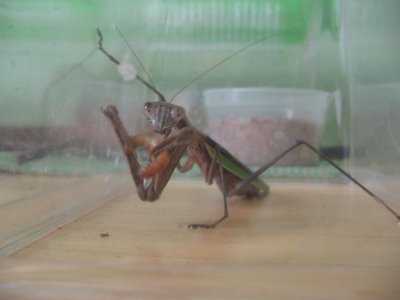
(Jerry the Praying Mantis, munching on a beetle larva.)
Number 1: They seem to be readily abundant. That’s undoubtedly something to do with their life cycle: females lay up to 300 eggs, with some hatching in small intervals. And that brings us to...
Number 2: They’re just going to die anyway. That’s because they hatch out in the spring, spend all summer preying (and “praying”), mate & lay their eggs in the fall, and then promptly die from old age or frost, "whichever comes first”.
And finally, Number 3: They are simply amazing to behold. I know, because I kept one last year—his name was Jerry. Fascinatingly, mantises are one of the few insects that can rotate their heads. They also appear to have excellent vision (their eyes are a curiosity unto themselves), and a mantis’ motions and behaviors seem almost as intelligent as those of a small vertebrate.
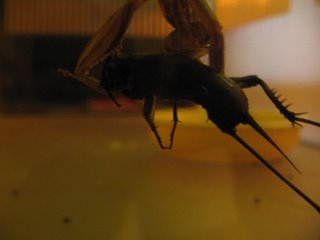
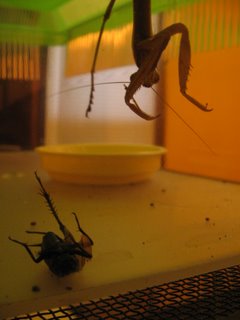
Of the four or five people who read this blog, I know I’ve got at least one predator-lover out there (you know who you are), so I’ll now say something a bit gory regarding how a praying mantis captures and consumes its prey. (The faint of heart should read no further.) Jerry would hang upside down and ‘swoop’ his spiny forelegs down to capture an unsuspecting cricket. Grasping it tightly to the point that it could not move, he would then chew a small, rectangular incision into the top of the cricket’s thorax (just below the vestigial wings), and proceed to munch the life right out of it. It’s awesomely gruesome, and guaranteed to send shivers right down your spine! (In fact I just got shivers merely thinking about it again.) Happily, no mantis poses any serious threat to human beings, though the mandibles can deliver a painful pinch, so just remember not to be foolish (like I was) and pick them up.
By the way, once your praying mantis finally kicks the bucket, you can easily preserve him for years (and quite nicely) with ethyl alcohol or formaldehyde. Barring that, rubbing alcohol will keep him looking like a sharp souvenir for several months.
Happy bugging, everybody!
PS: To prove to yourself what awesome predators praying mantises are, be sure to check out this website, Praying Mantis Makes Meal of a Hummingbird (it's for real!).
Update: From Wikipedia, more excellent photos of mantids here, including a link to a YouTube! video of a mantis capturing a cricket.
Monday, October 09, 2006
Death Becomes Autumn
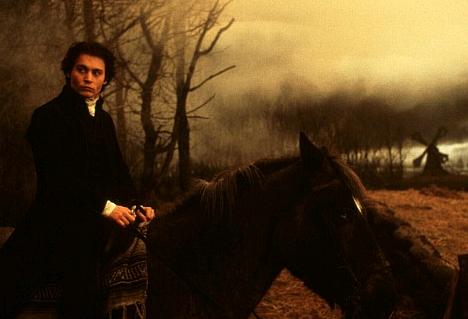 If you’re a fan of creatures and you live in a place that experiences winter—I mean real, lifeless, snowy abyss kind of winter—now is about the time of year when it starts to hit you that you’d better say your goodbyes. There is no better symbol of this time of year than the ambience of the Halloween holiday. For animals, the ominous stench of death is in the air. Plant food sources are going dormant, the night air freezes, and the most one can hope is that he has sufficiently fattened himself up in his previous months of (relatively) carefree existence.
The cloud of death sends amphibians scurrying for shelter under rocks, logs, and underground burrows. Some insects and spiders spin themselves in silken cocoons, perhaps desperately clinging to the belief that they are constructing insulation, not their coffins. Other insects simply give up, sitting patiently while the cloud of death descends upon them, assured by the sight of their eggs (which will weather the storm) that their existence till now has not been in vain.
I don’t here wish to be down on autumn or such “Halloween ambience”—the fact is, I love this time of year. (Along with spring, summer, and winter, autumn is my favorite season.) It’s hard not to love the thrill of the eeriness that accompanies the impending dormancy of life, since we all know that we don’t have to take it seriously—spring will come again.
Subscribe to:
Posts (Atom)

