Showing posts with label fun with the sky. Show all posts

Saturday, August 11, 2007

Meteor Shower This Weekend

Plan to head outside tonight or tomorrow night with your sweetie, a blanket, and a bottle of wine:

The Earth is making its yearly passage through a drifting path of debris left by a comet named Swift-Tuttle. The result? The annual Perseid meteor shower takes place!

You can probably expect to see 30-40 meteors per hour if you're viewing late tonight (Saturday); 45 per hour late Sunday night, and up to 80 per hour in the wee hours of Monday. For comparison, on a normal night any other time of year, the average rate is just 2-3 meteors per hour.

Naturally, the darker the skies, the more meteor streaks you're going to be able to see.

Why is this shower called "the Perseid shower", you might wonder? The meteors are entering the Earth's atmosphere in a small area in the direction of the constellation Perseus. This means is that if you trace the direction of the meteor streaks backwards, you will observe that they are "emanating" from Perseus. But you don't need to focus your gaze on any particular place in the sky to see them--just lie down and look around. (Reclining lawn chairs are a meteor-watcher's best friend.)

However, it may be the case that the higher in the sky Perseus is, the more meteors you are going to be likely to see. In other words: the later you view, the better. For locations in central and eastern North America, Perseus will be an "acceptable" altitude of 20 degrees above the northern horizon by 9pm to 10pm (an hour to two hours later if you're further west). If you're familiar with the W-shaped constellation of Cassiopeia, Perseus is just "below" that. The Stellarium screenshot below shows Perseus (far right) in relation to Cassiopeia, the Big Dipper (at far left), and the northern horizon. Click on this image to see a much enlarged version open in a new window:


In my experience,the Perseids are the best meteor shower of the year. Not only are they more numerous than most of the other annual meteor showers, but they occur in summer, a reasonably pleasant time to be outside at night. (Just don't be deceived: take a jacket!). It's especially nice that this year they've conveniently decided to occur on a weekend and a New Moon. : )


So, don't miss it!


(For more information: this article at Sky & Telescope has much of the same information as above, but contains a few additional interesting details.)

Saturday, July 28, 2007

Seeing in the Dark

Reports the SF Sidewalk Astronomers:

"Stargazing is the subject of Seeing in the Dark, a 60-minute, state-of-the-art, high-definition (HDTV) documentary by Timothy Ferris that premieres September 19, 2007 at 8:00 p.m. on PBS (check local listings).

The film, Ferris's third, is based on his book, _Seeing in the Dark_ (2002), named by the New York Times as one of the 10 best books of the year.

Seeing in the Dark will bring the wonders of the night sky in state-of-the-art HDTV to millions of viewers. The program features remarkable high-definition astrophotography, as well as the men and women, professionals and amateurs, who have seen and captured phenomenal images within and beyond our solar system and galaxy. It also explores how inexpensive telescopes, sensitive digital cameras, and the Internet now enable casual stargazers to get in touch with the cosmos.

Like the book, the film is in part a personal account of Ferris' life-long devotion to stargazing, beginning with his introduction to the night sky as teenager in Florida in the '50s.

'Seeing in the Dark is meant to alter, inspire and illuminate the lives of millions,' said Ferris. 'It introduces viewers to the rewards of first-person, hands-on astronomy--from kids learning the constellations to amateur astronomers doing professional-grade research in discovering planets and exploding stars. I hope it will encourage many viewers to make casual stargazing part of their lives, and a few to get into serious amateur astronomy.' "

Via Matthew Ota, Orange County Astronomers mailing list.

Friday, March 02, 2007

Partial Lunar Eclipse Tomorrow (But Not For Me)

If you're east of the Rocky Mountains tomorrow (Saturday), you'll get to see a partial lunar eclipse in the evening. Get the details (and an explanation of lunar eclipses) at this article on Sky & Telescope's website:

"This Weekend's Lunar Eclipse"

I won't be able to see it from California--the moon will have already grazed the Earth's shadow just before moonrise. I guess I'll just have to content myself with the sunny, 72 degree weather we have here instead. : P


Photo: a partial lunar eclipse in progress. If you didn't know any better, you might just think this is a crescent moon. But any familiarity with the curvature of the moon's usual shadow will inform you that something is amiss here--that's not a plain old crescent moon, it's a full moon passing through the shadow of the Earth! (And note that tomorrow night, the moon will be a full moon--so if you see anything otherwise, you can be sure it's the Earth's shadow involved.)

It is interesting to contemplate what one would see during a lunar eclipse if one were standing on the surface of the Moon: from the lunar perspective, it would in fact be a solar eclipse!

What would that look like, given that the Earth would appear much larger in the sky than the Sun? Well, you would see a ring of "sunlight streams" encircling the outside edge of the Earth's sphere--in other words, the sum of all sunsets happening at that moment on the Earth. It would undoubtedly look like a ring of reddish-orange. Two graphic artists have illustrated how that might appear: here is a high-quality composite illustration, imagined at the point immediately before or after the Sun is fully blocked (an effect known as "Bailey's Beads"), and here is an more instructive (though lower quality) animation of the process--to see it you'll have to scroll down to the second image on the page.
ADDENDUM: Be sure to note the shape of the Earth's shadow, as Aristotle and other ancient Greeks did. Prior to the Age of Discovery (e.g. Ferdinand Magellan's circumnavigation of the globe), this was one of a few phenomena that the Greeks had access to which had allowed them to infer, with certainty, the sphericity of the Earth.

Monday, December 18, 2006

Best Photography of Last Week's Aurora

As featured on today's Astronomy Picture of the Day, here are ten beautiful images of last week's aurorae:

http://www.nightskyevents.com/events_in_the_night_sky_main.htm

(taken near Des Moines, Iowa by photographer Stan Richard)

Thursday, December 14, 2006

The Auroral Display of December 14, 2006

ABOVE: The auroral display of December 14, 2006, as seen from North Dakota. Thanks to Jason Paul Smith for taking this photograph and posting it (along with many others) to the Creative Commons section of Flickr.

Aurora Report - Champaign, IL

My father called me around 6:45pm to tell me to hurry up and go outside. He was on his way home from work and reporting a spectacular auroral display from the countryside near Sycamore, IL (41°N & 88°W, 60 mi west of Chicago). I didn't manage to get any details from him other than that there were curtains fading in and out, and that he could even see them through the light polluted skies of some of suburbs along the northwestern horizon.

Here in Urbana, IL (150 mi south of Chicago; 40°N, 88°W) I headed out to a site with access to a clear & dark northern skyline (north Lincoln Ave.) around 7:00pm. It was evident even before I could pull over that the entire northern horizon was aglow with pale green. For the first fifteen minutes or so, looking due north I could see a few small curtains of green fade in slowly (over the course of 1-2 minutes each) and fade out again. They did not extend more than 15 degrees above the north horizon.

Then around 7:30pm, there was an outburst of more intense activity. Several beautiful and much more rapid green curtains, followed by some long "rays" of green extending as far as 25 degrees above the horizon, and added to this a large patch of red appearing off to the northwest in the head of Draco.

I had to leave at that point, but I returned around 8:30pm, only to find that the northern horizon had returned to being just a pale green glow.

This was my third or fourth display from central Illinois that I've personally seen, and of these experiences, the best yet (for me anyway). Much thanks to Mark Haun's email list for the heads up (for more information, see previous post).

Aurora TONIGHT in North America

Here we go again with celestial events...!

This just in from Mark Haun, owner of Aurora-Announce (and inventor of Aurora Alarm):

"Conditions over the past hour have become favorable for aurora. The current activity is due to a large solar flare which occurred Tuesday evening. The leading edge of the CME (coronal mass ejection) arrived at Earth this morning ~6 a.m. PST. Since then, the magnetic fields embedded in the disturbance were pointing the wrong way, until about 4 p.m. PST. Now the field is oriented southward, antiparallel to the Earth's magnetic field---the conditions necessary to fire up the aurora. If these conditions persist for a few more hours, we could have a very nice show in the US and Canada.

A major winter storm has all of Washington under cloud cover, so you should not expect an alarm on aurora-northwest, unless the aurora manages to trip the detector through the overcast. So, if you can get to a dark, clear site, I suggest you leave now. Good luck!"

(From aurora-announce mailing list)

Wednesday, December 13, 2006

Geminid Meteor Shower Peaks TONIGHT

Apologies for this late announcement (apparently I'm not on the ball!).

Writes a member of the Champaign-Urbana Astronomical Society:

"Four oddities in one night . . . .a major meteor shower . . . . . no Moon in the sky until after midnight . . . . a clear sky (so far anyway). . .and December temperatures in the upper 50's! Can you beat that? The Geminid meteor shower peaks tonight. Go out after 9pm and stay out as late as you can. Get a comfy chair and face basically up. And then be patient! The Geminids average about a meteor a minute."

Further info from Wikipedia:

"The Geminids are a meteor shower caused by an object named 3200 Phaethon, which is thought to be an extinct comet. The meteors from this shower can be seen in mid-December and usually peak around 12-14 of the month. The Geminid shower is thought to be intensifying every year and recent showers have seen 120-160 meteors per hour under optimal conditions. The Geminids were first observed only 150 years ago, much more recently than other showers such as the Perseids (August) and Leonids (November).

The meteors in this shower appear to come from a radiant in the constellation Gemini (hence the shower's name). However, they can appear almost anywhere in the night sky, and often appear yellowish in hue. The meteors travel at medium speed in relation to other showers, at about 22 miles per second, making them fairly easy to spot. The Geminids are now considered by many to be the most consistent and active annual shower. In 2005, viewing of the shower was restricted due to a full moon washing out the fainter meteors. The 2006 shower will have a less full moon."

Sunday, October 08, 2006

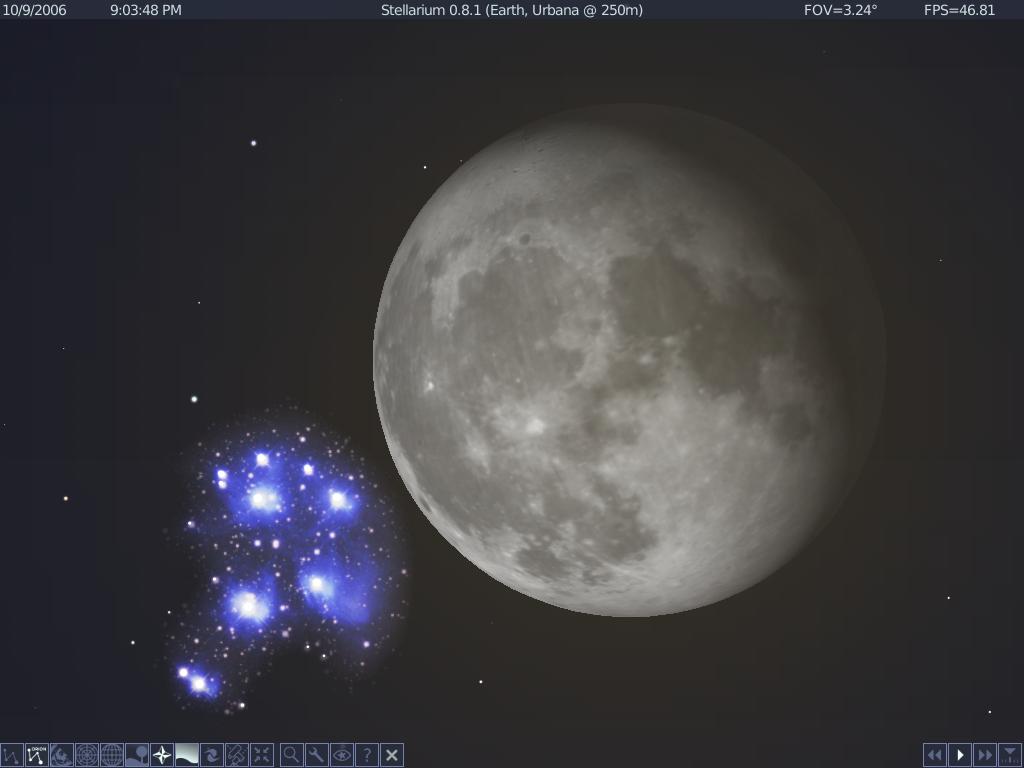
Moon to eclipse Pleiades TONIGHT (Monday)

(Image credit: a simulation using Stellarium)

Tonight the Moon will pass in front of the Pleiades, or "Seven Sisters", a cluster of several stars in the constellation Taurus clearly visible to the naked eye. Although not an exceedingly rare event, it is somewhat out of ordinary, and you might find it very pretty.

East Coast viewers, the Moon will be near the Pleiades when it rises (which will be around 8:00pm local time, shortly after sunset), and will start to pass in front of them around 10:00pm. It will almost completely cover them over the course of the hour, from 10:00pm to 11:00pm, and spend the rest of the night uncovering them and hanging out nearby.

West Coast viewers, the Moon will already be in front of the Pleiades when it rises (around 8:00pm local time), but if you duck your head out around 10:00pm it should be starting to uncover them, and it will spend much of the night doing so.

If you live in the Midwest, the happenings will be somewhere in between these two extremes. Basically, if you live in the Americas and you look outside at the Moon tomorrow night, you're guaranteed to see it either close to, covering, or uncovering, the Pleiades.

Unless it's cloudy... then you're guaranteed to see nothing.

The forecast for me here in Champaign-Urbana is mostly cloudy. :( So go look! I'll try to live vicariously through your experience.